



























Coin History
September 1, 2026
· 👁 166 views
Bitcoin vs Ethereum: What Really Separates BTC From ETH?
CR
Crypto Network Forum Blog
by @cryptonetworkforum · Sep 1, 2026
Bitcoin and Ethereum may share the crypto spotlight, but they are playing different games. One was built around scarce digital money. The other turned blockchain into a platform for applications, finance, and digital assets. That difference goes far beyond their prices and market caps.
As institutional interest, ETFs, stablecoins, tokenization, and Layer-2 networks reshape the crypto market in 2026, understanding what actually separates BTC from ETH has become more important than simply asking which one is bigger.
Bitcoin vs Ethereum: What Really Sets Them Apart?
Bitcoin and Ethereum may sit at the top of the crypto market, but their strengths come from very different foundations. Here’s a clear presentation of actual differences between BTC and ETH.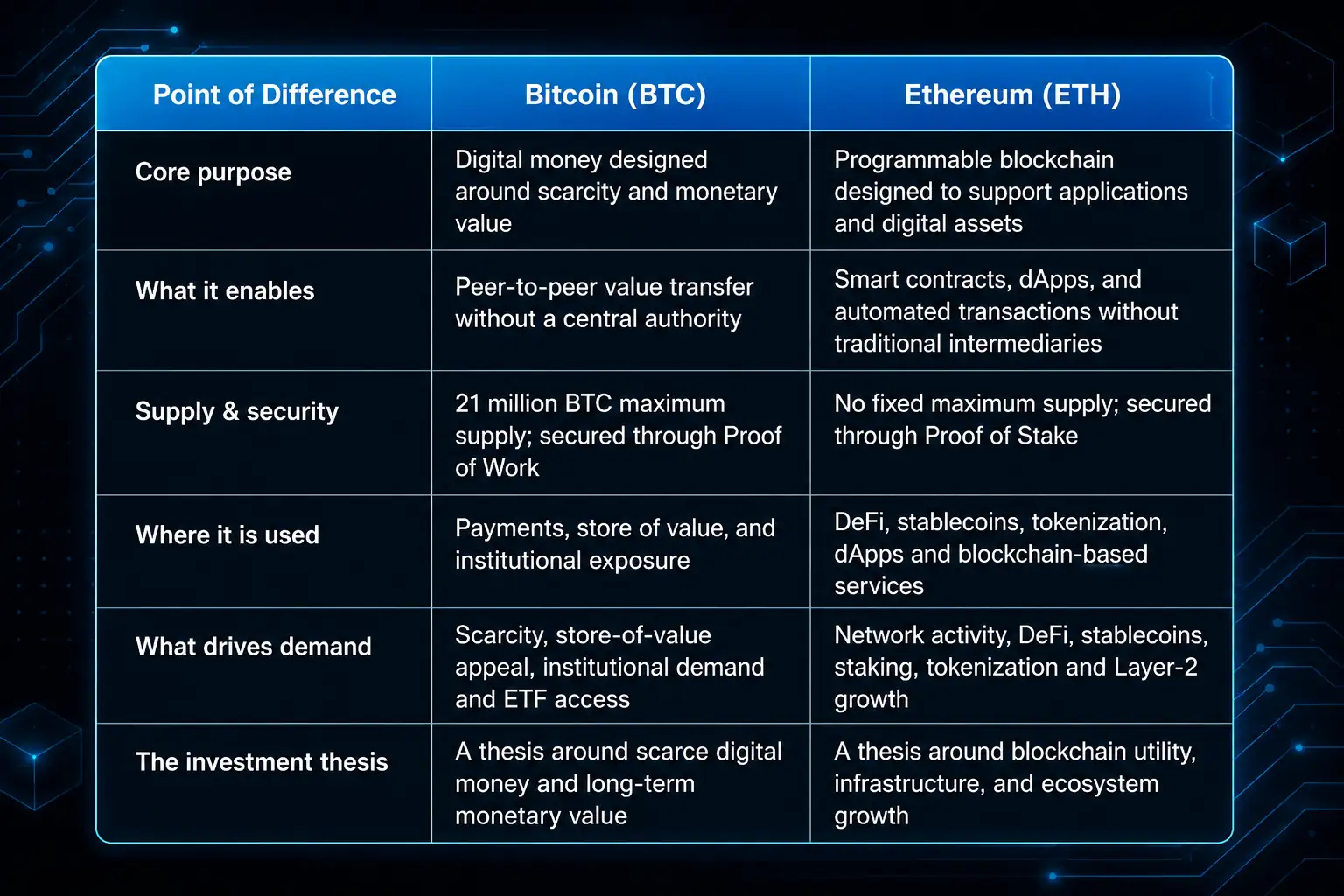
In short, Bitcoin is built around scarcity, while Ethereum is built around programmability and utility.
Bitcoin vs Ethereum as Investments
Bitcoin and Ethereum can both be major parts of the crypto market, but investors often look at them for very different reasons. Understand the idea behind each asset and what could influence its long-term value.Bitcoin is a Monetary and Investment Asset
Bitcoin's investment thesis is largely built around scarcity and monetary value. Its fixed maximum supply of 21 million BTC supports the idea that Bitcoin can function as a scarce digital asset and potential store of value. Institutional adoption and ETF access have also strengthened its position within traditional investment markets.For investors studying Bitcoin, the core thesis is relatively straightforward: demand for a scarce, decentralized monetary asset could support its long-term value as adoption develops.
Ethereum is a Blockchain Infrastructure Asset
Ethereum represents a broader blockchain utility and infrastructure thesis. Its network supports smart contracts and applications across DeFi, stablecoins, tokenization, and decentralized services. Layer-2 networks further extend Ethereum's ecosystem by handling activity while remaining connected to the underlying network.For investors studying Ethereum, the focus is therefore not only on ETH itself but also on the growth of activity built around the network. Its thesis centers on utility, applications, settlement infrastructure, and ecosystem growth.
How Institutions View Bitcoin and Ethereum in 2026
The institutional view of crypto has become broader in 2026.-Bitcoin is increasingly treated as a digital monetary asset, with regulated investment products making institutional exposure more accessible.
-Ethereum is attracting attention from a different direction: its network is being evaluated as infrastructure for stablecoins, tokenized assets, DeFi, and on-chain settlement.
-A 2026 institutional investor survey found that 66% of respondents had exposure through spot crypto exchange-traded products, while institutions also reported using stablecoins for cash management, payments and settlement.
This shift is visible beyond crypto investment products. Financial institutions are increasingly exploring blockchain for tokenization and settlement, with Ethereum positioning its mainnet and Layer 2s as infrastructure for these applications. For readers tracking these developments, Crypto Network Forum covers the latest trends across crypto markets, blockchain technology, regulation, and institutional adoption.
Bitcoin and Ethereum Are Not Really Competitors
Bitcoin and Ethereum are often compared because they dominate the crypto market, but they were built around different propositions. Bitcoin is a monetary asset built around scarcity, with its 21 million supply cap and store-of-value narrative at the center of its investment case. Ethereum is a programmable blockchain built around utility, supporting smart contracts, DeFi, stablecoins, tokenization, and a growing Layer-2 ecosystem.That makes the BTC vs ETH debate less about choosing a winner and more about understanding two different roles in the digital-asset market: Bitcoin as scarce digital money and Ethereum as programmable blockchain infrastructure.
Still debating Bitcoin vs. Ethereum? Join the conversation on Crypto Network Forum, share your take, compare perspectives, and connect with your community.
Frequently Asked Questions
Neither is universally better. Bitcoin focuses on monetary value, while Ethereum focuses on blockchain utility and ecosystem growth.
There is no universal answer. The choice depends on the investment thesis, risk tolerance, goals, and time horizon.
Ethereum supports more programmable applications, while Bitcoin focuses mainly on digital value transfer and monetary use.
No. Ethereum does not have a fixed maximum supply like Bitcoin. ETH supply changes through issuance and burning mechanisms.
Yes. They serve different purposes and can occupy different roles within the broader digital-asset ecosystem.