






















ETFs Simplified: What They Are and How They Work
Investing does not always mean picking one stock at a time. Sometimes, you can get several assets in one basket. That is where ETFs come into the picture. Think of them as a ready-made investment basket that trades like a stock.
ETFs have changed how investors approach the market. They offer a simple way to spread money across different assets without buying each one separately. From broad market funds to gold and crypto, ETFs now cover a wide range of investment choices. This flexibility has made them an interesting option for both new and experienced investors.
This article makes ETFs easier to understand. It explains how they function, the primary kinds, and the reasons behind investors investing in them. You will also learn about their risks and costs. The article also looks at how they differ from owning cryptocurrency directly.
What Is An ETF
ETF stands for Exchange-Traded Fund. It is a fund that trades on the exchange. A fund that has or reflects a collection of assets, including stocks, bonds, commodities, and cryptocurrencies.An investor is allowed to sell or purchase ETF shares on a stock exchange. This is convenient because they can be exposed to various assets in one go. It is like ordering a combo instead of all the items individually. Several things are provided under one umbrella. Similarly, an ETF provides you with exposure to multiple investments from a single investment.
ETFs have become a big part of the investment world. According to the Investment Company Institute (ICI), U.S. ETFs held $16.27 trillion in assets in August 2026. That is a notable jump from $13.4 trillion at the end of 2025, showing just how much the ETF market has grown.
How ETFs Work
An ETF begins when a fund provider creates a basket of assets. Stocks, Bonds, Gold or other investments. The fund is then designed to track a particular index, asset or investment theme. This fund is traded on a stock exchange like a share.As with stocks, investors can trade ETF shares during market hours once the ETF is listed. An ETF's price could change as the market conditions change during the day. It usually mirrors the performance of the assets it holds or tracks.
Think of an ETF that follows a group of popular companies. When those companies do well, the ETF may gain value too. When they struggle, its value can fall. So, one ETF can give you a simple way to invest in several companies at once.
Benefits of ETFs
ETFs are now a common option for many investors. They facilitate investing in a collection of assets rather than purchasing each one individually. Below are some of the key advantages that make ETFs worthwhile.1. Expert Management: Investment experts oversee a large number of ETFs. They manage your investments and adhere to the fund's plan.
2. Diversification: An ETF has the ability to own numerous businesses or assets simultaneously. Therefore, a single investment's poor performance could not have as large of an impact on the entire fund.
3. Low Entry Cost: It is not always necessary to start with a substantial sum of money. A comparatively minimal investment is also sufficient to purchase ETF shares.
4. Easy to trade: ETFs are traded on stock exchanges and can be bought and sold during market hours. This provides investors with added flexibility in investment management.
5. Tax Advantages: There may be fewer taxable capital gains to consider with some ETFs than with some mutual funds. This can result in tax savings to them in certain situations.
In general, ETFs can offer investors more flexibility and accessibility in investing. The advantages, however, will vary depending on the kind of ETF and the properties it contains.
What Are the Risks of ETFs
ETFs are not risk-free, despite their notable ease of use. Depending on the market and the assets they monitor, their value may fluctuate. Additionally, some ETFs concentrate on a single industry or asset, so they could not provide much protection during a downturn in that industry. To put it briefly, investment risk is not completely eliminated by distributing your funds across an ETF.Costs and real-world dangers must also be considered. The performance of an ETF may differ from that of the index or asset it tracks, and it might come with expenses. Additionally, certain ETFs have fewer buyers and sellers, which may make trading more difficult. So, it is always better to check what is inside an ETF before investing.
6 Different Types of ETFs
Not all ETFs are the same. Some span the entire market, others focus on one particular asset or industry. Below are some of the most common types of ETFs:Stock ETFs: These ETFs are composed of stocks from various companies. Some span across the general market, others are niche products targeting a specific industry. Several stocks are included in a single fund. The price of the ETF tracks the stock in which it is invested.
Bond ETFs: These ETFs combine various types of bonds into a single fund. They can consist of government bonds or corporate bonds. They can be a very basic method of incorporating bonds into your portfolio. They are still subject to price fluctuations due to changes in the bond market or interest rates.
Commodity ETFs: These ETFs are based on commodities like gold, silver or oil. They allow you to buy commodities without actually keeping them in your possession. Their performance typically is related to commodity price movement.
Index ETFs: These ETFs follow a particular market index. You don't select the companies individually but invest in a fund that tracks the stock index. This can provide you with a number of companies at a single time. If the index goes up, the ETF tends to go up.
Industry (or sector) ETFs: These ETFs are designed to track a particular sector of the economy, like technology, healthcare, energy, etc. They are helpful when you want to concentrate on a specific market segment. However, this limited coverage can also create more risks.
Crypto ETFs: These are the ETFs that allow investors to gain exposure to cryptocurrencies through an investment fund. It may rely on futures contracts or track the price of a cryptocurrency, depending on the fund. Crypto ETFs can be a more convenient choice for individuals that don't wish to deal with crypto wallets themselves. They still have the ups and downs of the crypto market though.
Each ETF has a different focus and has its own purpose. Some are broader and others more specific. It is important to understand the contents of an ETF when choosing.
ETF vs Mutual Fund
Initially, ETFs and mutual funds might appear the same. Both pool funds from investors and utilize them to construct a portfolio of assets. The key difference is in the way they are sold, bought, priced and managed. Below is the table explaining its main differences :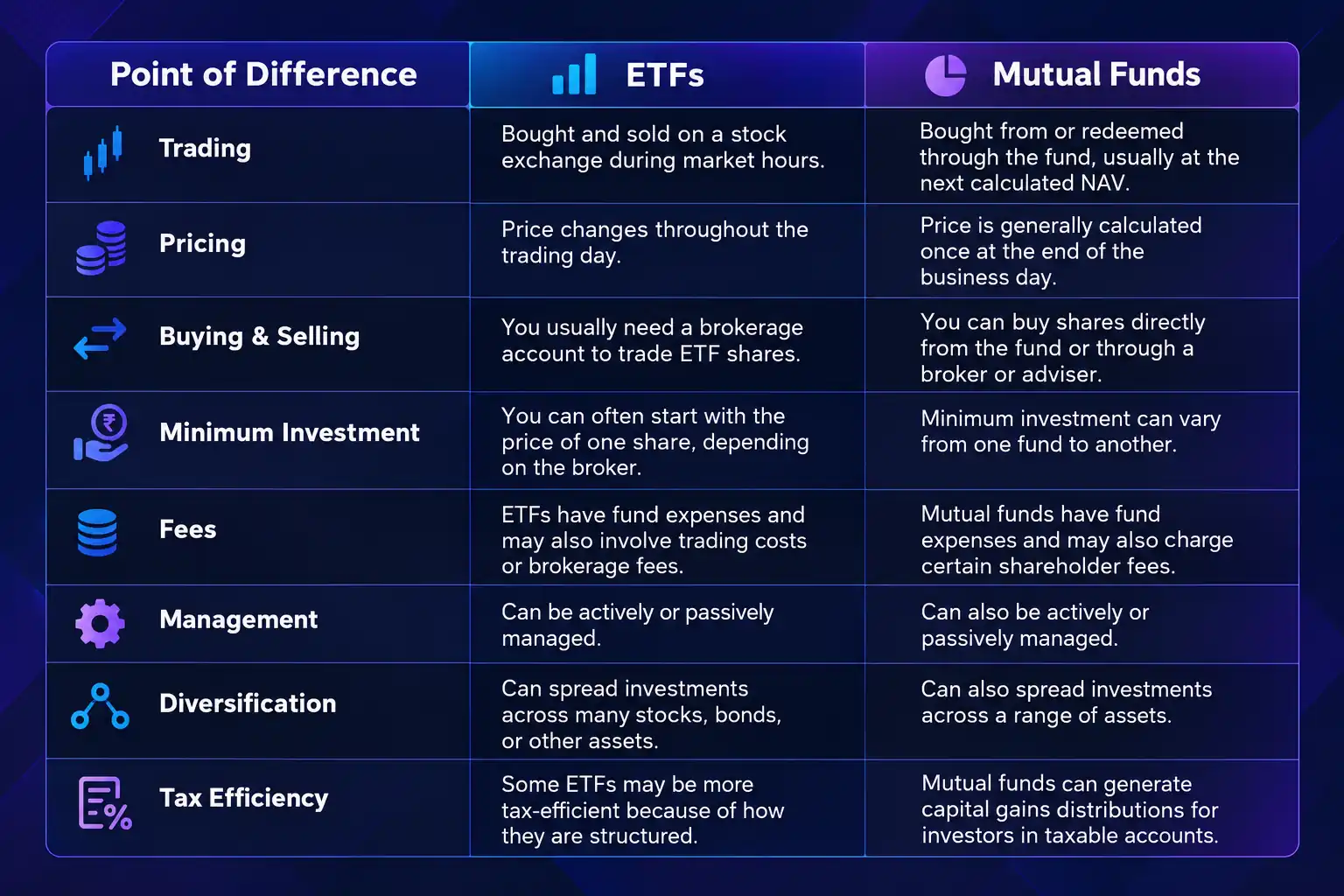
Both ETFs and mutual funds are useful investment options. The better choice depends on your goals, budget, risk tolerance, and investment style. As investors compare different options and follow changing market trends, discussions with other investors can also offer useful perspectives. The Crypto Network Forum provides a space to explore cryptocurrency, market trends, and digital asset discussions with other enthusiasts. It can be another place to keep learning and exchange ideas as you build your understanding of different investment options.
What to Check Before Buying an ETF
Before you buy an ETF, it is worth taking a little time to understand what you are putting your money into. Go through the fund’s prospectus and latest shareholder report to get a clear idea of what it holds, what it aims to do, what it costs, and what risks come with it. You can usually find this information on the fund’s website or through the Securities and Exchange Commission (SEC).The budget and goal of investment should be clear before investing. If something about the fund is not clear , take time to understand it. You should know what your money is going into, who is managing the fund, and what happens when you eventually decide to sell your ETF shares.
Markets can change quickly, and keeping up with different trends is not always easy. Share your thoughts on the Crypto Network Forum and connect with others to discuss cryptocurrency prices, token movements, and the latest market developments.