



























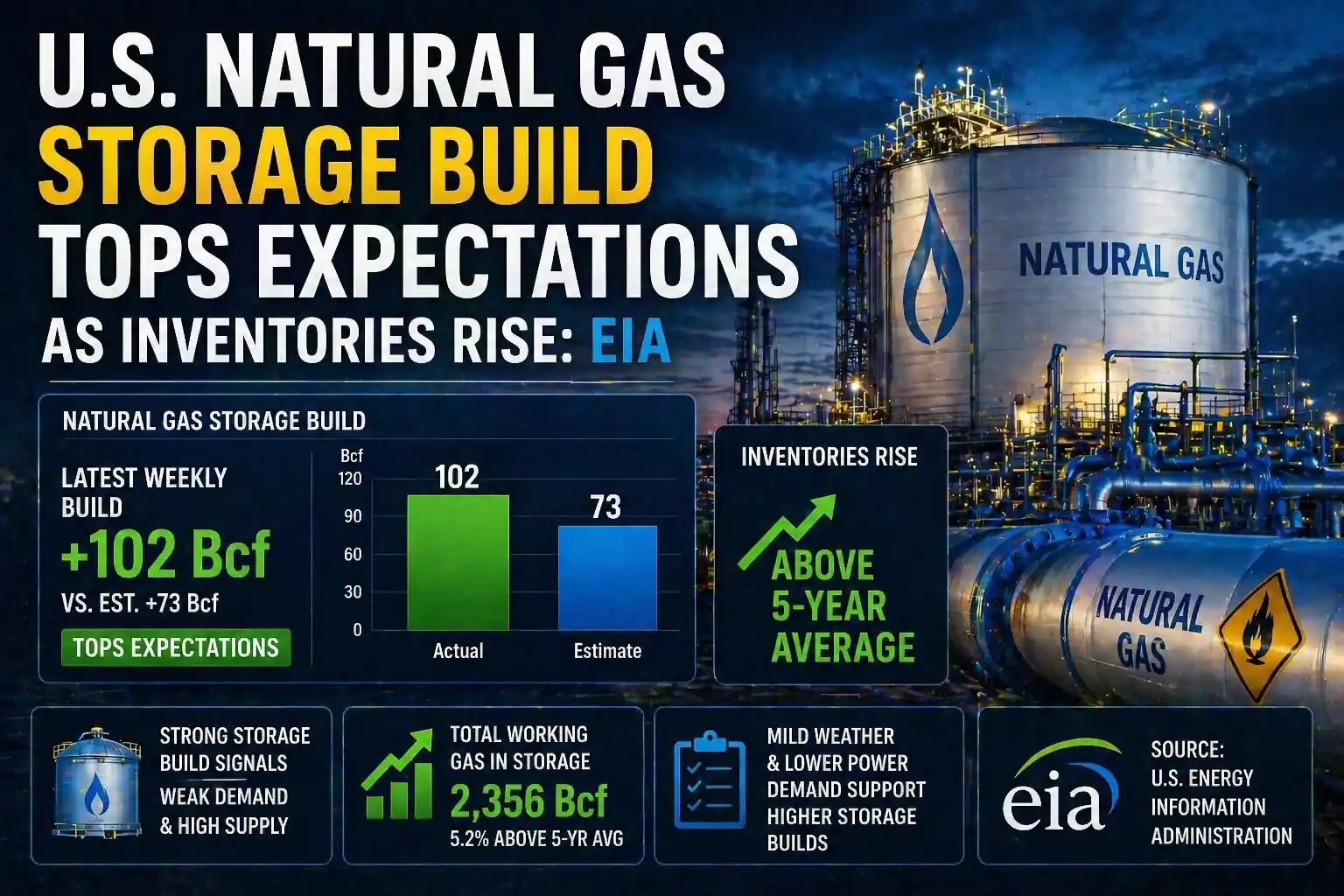
U.S. Natural Gas Storage Build Tops Expectations as Inventories Rise: EIA
The inventory of natural gas recorded a surprising increase in the recent weekly report released by the US Energy Information Administration (EIA). The current situation shows that there is an abundance of supply for natural gas during the present injection period of the spring.
As per the US Energy Information Administration (EIA), the natural gas working inventory in the underground storage of the Lower 48 States grew by 103 billion cubic feet (bcf) for the week ending April 17, 2026. This brought the inventory level to 2,063 bcf.
In comparison with the corresponding week last year, inventories were higher by 142 bcf. Meanwhile, stocks exceeded the five-year average by 137 bcf at 1,926 bcf, pointing to abundant supply conditions in the current period. It was stated that total stocks remain within the normal range compared to the past five years.
Regional Breakdown of Weekly Storage Injection
Several major regions contributed to the weekly build:
-East Region : +26 bcf to 309 bcf
-Midwest Region : +33 bcf to 404 bcf
-Mountain Region : +2 bcf to 202 bcf
-Pacific Region : +2 bcf to 269 bcf
-South Central Region : +40 bcf to 879 bcf
The South Central region, which includes key storage hubs in Texas and Louisiana, accounted for the largest share of the weekly increase.
Market Reaction
Futures prices are usually pressured by any build exceeding expectations since higher-than-expected builds would indicate low demand or sufficient production. There are still many opposing factors that the traders have to take into consideration, for example, weather forecasts, LNG exports, and pipeline activities.
Hotter-than-usual summer weather would immediately increase demand from power plants for gas-fired electricity generation in the coming months.
This development occurs during the injection season, when utility firms build up their stockpiles in preparation for winter consumption. Future stockpile increases will be closely monitored to see if stocks continue to rise faster than average.
If this trend persists, then the United States would enter the summer season with one of its highest stocks on record, which may hamper future gains unless extreme weather conditions and supply disruptions occur.
Key Drivers for Investors
The parties operating in the market should carefully watch the forecasts for temperatures during the summer season, the use of liquefied natural gas (LNG) facilities, the production of shale gas in the United States, any disruptions in the pipelines, and the weekly inventory reports by the Energy Information Administration (EIA). All these could have significant effects on the supply and demand conditions within the natural gas market. Given that the current inventories are well-stocked, the price of natural gas will be responsive to weather-induced demand changes.